Feeds:
Posts
Comments

Archive for the ‘Tangents’ Category

Alright, I know American Thanksgiving is still a couple of weeks away. And of course, my people already had our day of turkey and root vegetables a month back. Still, I’d like to express my gratitude for the time I’ve spent in New York this week – and on all my previous visits, too.

I think I tend to be a fairly practical person, grounded in the here-and-now and not prone to seeing any kind of larger meaning in the happenings around me. But for a long time now I’ve imagined a sort of mystical connection between my writing career and my time in NYC. Whenever I come to visit, it seems, good things happen: I got an email offering me my first ever magazine assignment while I was working at the NYPL during a short visit in May 2008; I flew in on my last airline points for a Restless Legs reading in October 2008, and during the post-event schmoozing an editor offered me a monster writing contract that cleared away my credit card debt and got me out of my mother’s spare room (thanks, Mom!); on every trip here I’ve met writers in person whose work I’ve admired online and in print, and found invaluable inspiration in talking to them at bars, coffee shops, restaurants and the occasional swanky PR event.

New York even manages to clear room in my schedule for those solitary basics I often neglect at home: a rainy afternoon in a coffee shop or a quiet night on the couch, getting caught up on my magazine reading.

Of course, a lot of that good fortune I just described can be attributed to the generosity of the travel writing community here in New York, rather than serendipity. Still, it’s hard to shake the idea that the city is my good luck charm.
(more…)

Read Full Post »

The April 26th issue of The New Yorker included a series of letters Bellow wrote to his fellow authors, critics, and other publishing figures – everyone from Philip Roth to William Faulkner to John Cheever. As I’ve mentioned before, I can’t get enough behind-the-scenes glimpses at the writing lives of authors I admire, so naturally I found the letters fascinating. One in particular, though, caught my attention. It’s a 1948 note to David Bazelon, about a recent work of Bellow’s. Here goes:

It took hold of my mind and imagination very deeply but I know that somehow I failed to write it freely, with all the stops out from beginning to end. They were out in a few places. I could name them. And I must admit that in spite of the great amount of energy I brought to the book at certain times, I was at others, for some reason, content to fall back on lesser resources… [T]here is a certain diffidence about me, not very obvious socially, to my own mind, that prevents me from going all out, as you call it. I assemble the dynamite but I am not ready to touch off the fuse. Why? Because I am working toward something and have not yet arrived. I once mentioned to you, I think, that one of the things that made life difficult for me was that I wanted to write before I had sufficient maturity to write as “high” as I wished and so I had a very arduous and painful apprenticeship and still am undergoing it. This journeyman idea has its drawbacks as well as its advantages. It makes me a craftsman – and few writers now are that – but it gives me a refuge from the peril of final accomplishment. “Lord, pardon me, I’m still preparing, not fully a man as yet.” I’m like the young man in the Gospels, or have been till lately. “Give all thou hast and follow me,” says Christ. The young man goes away to think it over and so is lost. There’s a limit to thinking it over…

This idea of holding something back, of having these aspirations for your writing and wanting to wait until you’re really “ready,” until your apprenticeship is over, to tackle them in full, really resonated with me. It’s the sort of thing that crosses my mind every time I dream up another book idea – “I’m still preparing.” At a certain point, I suppose you just have to light the fuse.

Oh, and in case I owe you a World Hum-related email, here’s another relevant line from Bellow: “Forgive my having the manuscript so long. I should have read it at once. But I don’t live right.”

Read Full Post »

I wanted to draw attention, briefly, to this essay we published at World Hum last week: Inspiration, Travel Writing and L’Esprit Frondeur. It’s by Atlantic correspondent Jeffrey Tayler, and it’s about how he became a writer. I always get a kick out reading the “how I got started” stories of writers I admire, but I especially appreciated this one for making an important and surprisingly regularly overlooked point:

I’d like to clarify something fundamental. I take for granted that if you want to be a writer, you’re a wordsmith, a lover of the classics and a connoisseur of literature. Writers must, initially and throughout their lives, be readers first and foremost, and readers not primarily of journalism, but of the classics, both modern and not-so-modern. I also take for granted that aspiring writers know how to compose a proper declarative sentence and don’t misuse words. Reading the classics will help hone your ear, but there are many good books on usage out there and writers should read and digest them and reread them. Inspiration and an esprit frondeur won’t help aspiring writers who don’t know the basics of their craft. No matter what motivates you, no matter what experiences you have and seek to put down on paper, editors buy well-written words, and your writing has to be exceptional if it is to see print.

In all the talk about building your online brand, social media, and so on, this basic point – that aspiring writers should love words and know how to use them – can sometimes go overlooked. So thanks for the reminder, Jeffrey.

Read Full Post »

Some Thoughts on Laura Dekker

That’s the Dutch fourteen year-old who’s been blocked by a Netherlands court from attempting to sail around the world solo – she’d been aiming to set a new world record for the youngest sailor ever to manage the feat. After she managed to run away to the Caribbean last week, defying a court order, she’s facing not just occasional monitoring by childcare authorities – they’re actually talking about taking her into protective custody.

Ever since I heard of Dekker a few months back – when her attempt was first postponed, while she was still just thirteen – I’ve been trying to sort out my feelings on the case. On the surface, the whole thing seems absurd, a clear over-reach on the part of Dutch authorities: After all, she’s an experienced sailor, and her primary guardian, her father, is entirely behind the effort. (Her mother is against it.)

But then questions start to pop up. For instance: Is it really that far beyond standard levels of government “interference” in child-rearing?

(more…)

Read Full Post »

A couple of quick notes: First, this past Friday at World Hum was devoted to “Up in the Air,” the travel-themed movie that looks set to tear up the awards circuit this year. It was adapted from a Walter Kirn novel of the same name, which Jim and Mike have been keeping tabs on since World Hum was brand new. (Among other things, the novel is the source of one of our main themes – “Airworld.”)

Here’s our coverage:

Beyond Airworld – A look at “the bittersweet challenge of the traveler’s life”

A video interview with director Jason Reitman and author Walter Kirn

A whole whack of links related to the movie, the book and Airworld in general

I haven’t seen the movie yet, but here’s hoping it makes it this far north.

Second, I’m thrilled to see that a travel book has FINALLY made its way into the What is Stephen Harper Reading? project. If you’re not familiar, WISHR is author Yann Martel’s one-man effort to make our illustrious Prime Minister more appreciative of the arts – or, in his own words, “to make suggestions to his stillness” – by sending him a series of carefully chosen books. The latest? “Tropic of Hockey” by former Rheostatics frontman Dave Bidini. Here’s what Martel had to say in his accompanying letter to the PM:

Tropic of Hockey is about one man’s love for the game and his quest for its soul. This quest leads him to places where you wouldn’t expect to see ice hockey. And as different as those places are, the spirit of the game, by Bidini’s reckoning, burns with the same intensity as it does in his rec league in Toronto. He finds in Harbin, northern China, in Dubai, in Miercurea Ciuc, Transylvania, the refreshing purity of a game that is not mere entertainment but a way of meeting and being, hockey as culture rather than business, “the spirituality of sports, sports as life,” as he puts it at one point.

I’ve been meaning to read this book for a couple of years now, so thanks, Yann Martel, for the reminder. (And for the effort to expand Prime Minister Harper’s stillness, too.)

Read Full Post »

It’s been four years today since Hurricane Katrina had her way with New Orleans and the Gulf Coast. We’ve got a raft of anniversary-related content over at World Hum, and though I didn’t write any of it myself I thought it was worth highlighting here.

First up, Yeah You Right, a wonderful essay by Adam Karlin that seems to take a number of never-quite-articulated thoughts right out of my head. (See especially the last couple paragraphs about the visitors who feel compelled to make a home for themselves in NOLA.)

There’s also Kevin Fay’s essay about a voluntourism stint in St. Bernard Parish — Do Not Demolish — and a slideshow and interview from photographer Allison Chipak.

As you might already know, I spent a good chunk of last summer in New Orleans. I’d been intending to cover the third anniversary of Katrina when Hurricane Gustav broke up the party and forced the evacuation of the city. The blog post I wrote about it is here: Remembering Katrina, Waiting for Gustav.

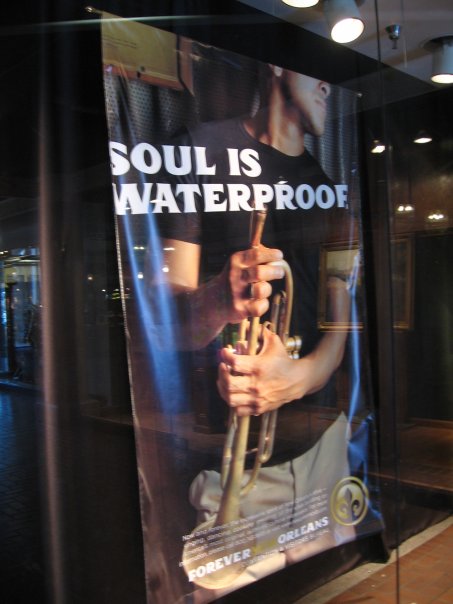
New Orleans: Soul is Waterproof

New Orleans: Soul is Waterproof

Read Full Post »

I try not to get into politics on here, but this needs to be said:

Working, studying, living or traveling abroad, even for years at a time, does not make you less Canadian.

Prime Minister Harper and his cronies might think they’re only attacking the Liberal leader with their IGNATIEFF: JUST VISITING campaign, but they’re actually insulting and dismissing any of us who’ve made being abroad an important part of our lives. ESL teachers? Diplomats? Foreign correspondents? Members of the military? Doctors without Borders volunteers? PhD students on Rhodes Scholarships?

By the logic of “Just Visiting,” all those people have somehow reneged on or forfeited their essential Canadian-ness. And that kind of attitude is plain ignorant.

This isn’t about party or personal loyalties. I don’t have much use for Michael Ignatieff – let’s start with his writings on torture and go from there – and I’m certainly not a card-carrying member of the LPC. I’d even be fine with a more nuanced argument: Maybe Ignatieff is out of touch with the issues that matter to Canadians after his years overseas, right? Or maybe politicians should have deeper roots in their constituencies? (Tell that to any number of parachuted-in MPs.) Sure. Maybe.

But the Harperite equation isn’t that complicated. As far as I can tell from the ads and flyers, it’s simply this:

Living overseas = No true commitment to Canada.

And that, pardon my language, is bullshit.

If all goes as planned, I’ll spend good chunks of the next few decades out of the country. As I’ve done for the last few seasons, I’ll watch bits and pieces of the Stanley Cup playoffs on obscure cable channels in foreign countries, plead with bartenders in sports bars to change the channel away from basketball and soccer, or watch a shaky CBC feed on the web. I’ll keep up with the news back home on globeandmail.com. I’ll have my parents mail me my tax forms and file them from wherever I find myself, and I’ll request an absentee ballot at election time.

At no time do I expect to stop thinking of myself as Canadian.

And when I come home, whether for a week or a year? I sure as hell won’t be just visiting.

Read Full Post »

A quick deviation

Not travel- or work-related, but I just came across this news item about a New Hampshire high school that has pulled short stories by David Sedaris, Stephen King and Ernest Hemingway from an upper-year English lit class because parents objected to the content.

Here’s the scariest sentence from the article:

Also, a committee of teachers, parents and residents will be formed in the fall to “help prevent undesirable experiences for our students,” Cutler said. [Emphasis mine.]

In related news, they’ll also be setting up a committee to figure out how to catch and burn those darn witches.

Read Full Post »

« Newer Posts