Feeds:
Posts
Comments

I just booked two nights in a little log cabin a couple of hours south of Whitehorse, complete with glacier views, a woodstove, and — crucially — an electrical outlet for my laptop. I’ve got a bunch of writing I’m aiming to get done in a short time span, so I figured I’d fashion my own little retreat.

Self-imposed writing seclusion is an experiment I’ve been meaning to try for awhile. I’m headed out later this week; here’s hoping I come back on the weekend a few thousand words richer.

I picked up this little booklet on a whim at the public library last week. It’s the transcript of a Q&A with Stegner, Pulitzer-winning novelist and the founder of Stanford’s creative writing program, and in the same way that fiction writing advice often crosses genre boundaries and offers help to nonfiction writers, this book — aimed at writing teachers — is equally thought-provoking for any writer looking to improve their work.

I’ll likely post a few quotes from it over the next couple weeks. To start with, here’s Stegner on that essential question: Can writing be taught?

[T]here are limited things that a teacher can do, apart from encouraging the environment of interest and criticism within which writing can take place. How can anyone “teach” writing, when he himself, as a writer, is never sure what he is doing?

Every book that anyone sets out on is a voyage of discovery that may discover nothing. Any voyager may be lost at sea, like John Cabot. Nobody can teach the geography of the undiscovered. All he can do is encourage the will to explore, plus impress upon the inexperienced a few of the dos and don’ts of voyaging…

In my experience, the best teaching that goes on in a college writing class is done by members of the class, upon one another. But it is not automatic, and the teacher is not unimportant. His job is to manage the environment, which may be as hard a job as for God to manage the climate.

I’m only partway through and I’ll be interested to read what’s left — I spent my high school years enrolled in an intensive creative writing program and I’ve always thought that its greatest value lay in its ability to expose me to new writing styles and genres and to make me attempt them all, and then to force me to edit the results mercilessly.

No single piece of advice from any of my teachers sticks out: Mostly I remember being forced to read, read, read; write, write, write; edit, edit, edit. It wasn’t always a fun process, but it certainly got me writing more — and eventually, writing better — than I ever would have on my own time.
This short piece I wrote about the best beaches in Barbados was just published in the Ottawa Citizen and the Vancouver Sun. I’m off to Barbados again in April — lucky me!

I’m slowly working my way through Raban’s Passage to Juneau, a travel narrative about a sailing voyage from Seattle through the Inside Passage to Alaska. Early in the book, he reveals the role that his boat played before the trip:

Though I lived in a house overlooking the canal, and could see from the upstairs deck whether or not the boat still floated, I usually spent several weeks a year, and sometimes months, aboard the ketch. When a concentrated bout of reading was called for, or a wrong chapter needed righting, or when my Furies dogged me to distraction, I’d take off for the nearby scribble of islands and let go the anchor. With the floor sashaying underfoot, the chain grumbling on the sea-bottom, and the view from the boat’s windows revolving slowly on the tide, I found the equilibrium that I was prone to lose on the unstable land. On winter mornings, the mud foreshore hoar with frost, forlorn gulls circling under a misty sky, I’d fire up the heater, light the lamps, and work with an intense single-mindedness that evaded me at home. The creaks and groans, the smell of paraffin and diesel, were conducive to thinking and remembering. Afloat, the boat was an unplace — a bubble world, off at a useful tangent to the insistent here-and-now of the American shoreline.

I’ve got a few odds and ends to catch up on.

First of all, I’ve had a handful of stories published over on the Matador Network in the past couple weeks: an introduction to a serious local ultra race — The Yukon Arctic Ultra: The World’s Toughest Race? — and two stories about my Alaskan beer adventures. Check out The Beer Frontier: Binge Drinking in Alaska and the accompanying Guide to Beer Drinking in Alaska.

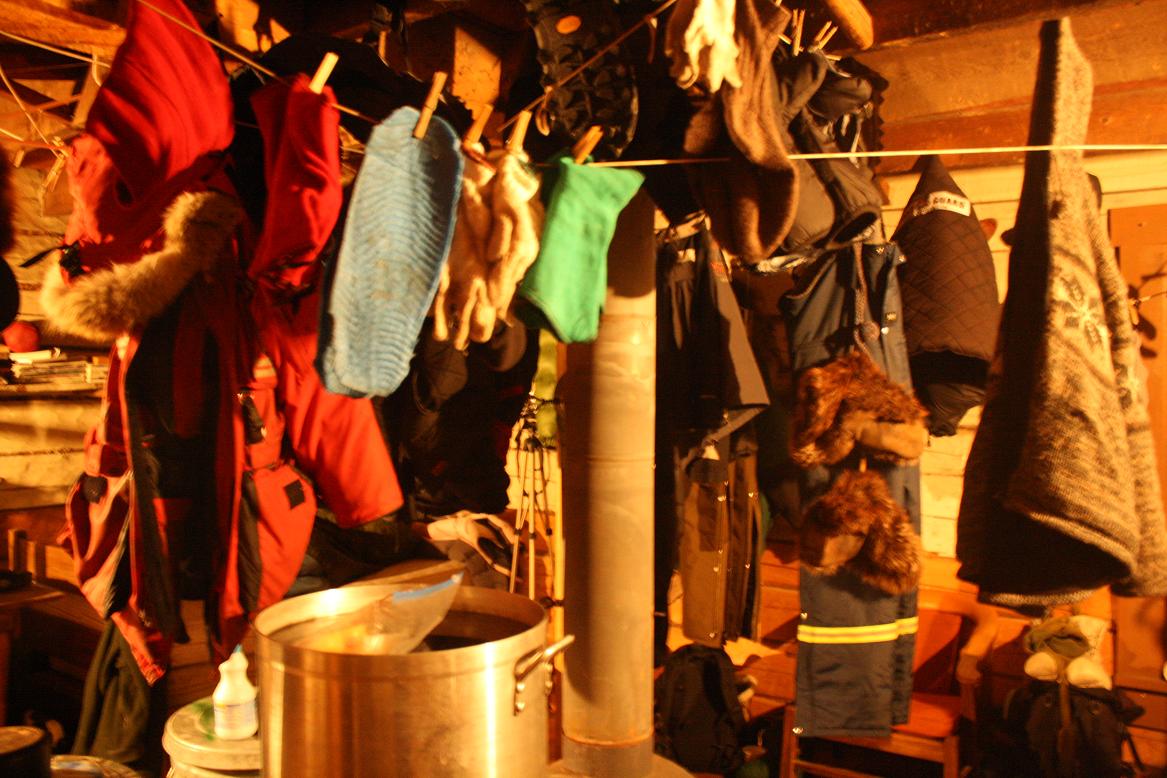
Next up, a photo from my time at Slaven’s Roadhouse.

On my first night, we had 7 mushers and more than 75 dogs pass through, in addition to the 8 volunteers, the race judge and the veterinarian already camped out there. As you can imagine, the result was an awful lot of parkas, mittens, dog booties and other wet winter gear hanging up above the wood stove:

It’s been a busy few weeks, with nearly 5000 new kilometers added to the odometer in my Jeep, and as always I’ve come back from my latest trip to Alaska with more ideas than I know what to do with. I think I’m ready to settle down for awhile and do some serious reading, pitching and writing.

I arrived home in Whitehorse last night after a successful trip into Yukon-Charley Rivers National Preserve — I was a volunteer at Slaven’s Roadhouse, a remote dog drop location on the Yukon Quest trail. Photos and more coming soon, in the meantime I’ll just note that using an outhouse at -50 (a new experience for me) wasn’t nearly as painful as I’d expected.

It’s funny: I went years without hearing about DFW, and now, in the weeks since I finally started reading his work, I see his name everywhere.

Wallace comes up in that Jon Krakauer interview I posted last week (apparently Krakauer tried and failed to read “Infinite Jest” at Everest Base Camp) and in this Financial Times piece about the art of writing a great sentence.

Best of all, just after I started reading Consider the Lobster I came across a long, previously unpublished interview with Wallace, which appeared on Slate’s Scocca blog in several parts. It focuses on his nonfiction writing, and it’s a really great read.

David Foster Wallace on Nonfiction, 1998:
Part 1: “I’m Not a Journalist and I Don’t Pretend To Be One”
Part 2: “My Big Problem With Magazines Is That They Tend To Have Word Lengths”
Part 3: “There’s Going To Be the Occasional Bit of Embellishment”
Part 4: “I Will Slice Open My Head For You”
Part 5: “It’s Not Very Good for Me When People Treat Me Like a Big Shot”

…my first ever travel story was published in The Ottawa Citizen. Time flies, huh?

Over the course of a few weeks last year, from mid-November to late December, I read my way through David Foster Wallace’s second essay collection, Consider the Lobster — and I’ve been trying to gather my thoughts and write something coherent about it ever since. Trouble is, I was so overwhelmingly impressed by the book that I can’t seem to get beyond an initial layer of breathless fangirlism to whatever more, er, thoughtful thoughts may lie underneath.

Wallace and his writing had initially passed me by entirely. My first clear recollection of his name coincides with his 2008 suicide: co-editor Jim Benning wrote a brief obit post for the World Hum blog, and over the next few days I followed a trail of links and wondered how I’d missed hearing about the writer whose death had lit up the internet.

Over the next couple of years, I continued to see Wallace’s name pop up here and there, on World Hum and beyond; I even wrote a couple of Wallace-related blog posts myself. But apart from a few excerpts, I still had yet to sit down and give any of his work a proper read.

With “Consider the Lobster,” I’ve finally remedied that. And boy, am I glad I did.

Continue Reading »

A quick (but pretty major) update on my end: I launched a new blog this morning, Travelers North.

The aim is to offer a mixture of photos, links, personal notes and practical guidebook-style information about travel in Alaska, the Yukon and (eventually) NWT, Nunavut and beyond. I’m pretty excited about it.

The accompanying Twitter feed is here: @travnorth. Check it out!